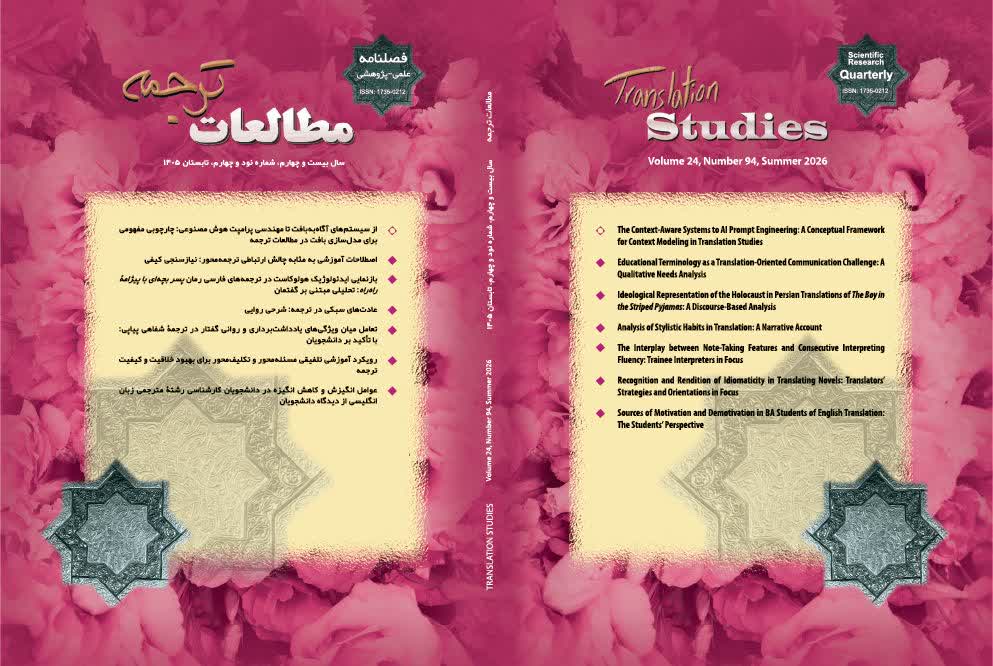
Recognition and Rendition of Idiomaticity in Translating Novels:
Translators’ Strategies and Orientations in Focus
Abstract
Translators may resort to different strategies to meet the requirement of rendering the significance of a text into its translation. This is all the more so considering such demanding portions of literary texts as idiomatic expressions. This study scrutinized various strategies and orientations adopted by the translators in conveying the idiomatic expressions of Into the Magic Shop, the Catcher in the Rye, and the Great Gatsby, employing Baker’s theoretical framework. Comparing and contrasting the specific source texts (STs) containing various idiomatic expressions with their corresponding target texts (TTs) indicated that mostly the improper recognition and transference of the semantic aspects involved in the idiomatic expressions were noticeable in the TTs. Meanwhile, translation by employing idioms with identical meanings and unlike forms and paraphrasing were the most frequently applied strategies by the translators to render the idiomaticity at work. Considering different semantic aspects involved in idioms and the complex procedure of grasping their semantics, the study findings might lend insightful contribution to enriching the current understanding of the complexities of idiomatic expressions and their renditions, particularly concerning glaring disparities between the languages under study, that is, English and Persian as regards their stylistic preferences.
References
Asylbekova, E., & Jidong, W. (2023). Translation challenges of English idiomatic expressions into Russian language: A comparative study. International Journal of Social Science Humanity & Management Research, 2 (3), 165-167. DOI:10.58806/ijsshmr.2023.v2i3n03
Baker, M. (2018). In other words: A coursebook on translation. Routledge.
Doty, J. R. 1. (2016). Into the magic shop: A neurosurgeon’s quest to discover the mysteries of the brain and the secrets of the heart. Kindle Edition.
Doty, J. R. 1. (2016). Maghaze-ye-jaduyi [orig. Into the Magic Shop]. (F. Saedi, Trans.). Majazi.
Fitzgerald, F.S. (1993). The great Gatsby. United Kingdom: Wordsworth Editions Ltd.
Fitzgerald, F.S.(2000).Gatsbee-ye bozorg [orig.TheGreatGatsby](K.Emami,Trans.).Niloofar
House, J. (2014). Translation: A multidisciplinary approach. Palgrave Macmillan.
Laviosa, S. (2021). Corpus-based translation studies: Theory, findings, applications (Vol. 17). Brill.
Lee, T. K. (2020). Ideology. In Baker M. & Saldanha G. (Eds.), Routledge encyclopedia of translation studies (3rd ed.) (pp. 252-256). Routledge.
Premasari, A. A., & Widodo, P. (2021). Translation strategies of idiomatic expressions in the novel Edensor. International Journal of Linguistics, Literature and Translation, 4(2), 64-69.
Putri, D. I., & Rejeki, S. (2021). Types of idioms and strategies in translating idioms in the novel The Girl on The Train by Paula Hawkins. Journal Albion: Journal of English Literature, Language, and Culture, 3(2). DOI:10.33751/albion.v3i2.4530
Salinger J. D. (1958). The catcher in the rye. Penguin Books.
Salinger, J. D. (2014), Natur-e-dasht [orig. The Catcher in the Rye]. (A. Barseghian, Trans.). Milkan.
Wahyu T, Syamsul R., & Pebri Prandika P. (2026). Translation strategies and difficulties in translating English idiomatic expressions. Jurnal QOSIM : Jurnal Pendidikan Sosial & Humaniora, 4(4), 7568–7577. https://doi.org/10.61104/jq.v4i4.11984
Zandian, S. (2020). A new trend in translation quality assessment (TQA): A practical rubric to assess the quality of literary translation. [Doctoral dissertation]. Isfahan University, Isfahan.
Zandian, S. (2022). Examining idiomaticity of short stories in translation: Creativity or fidelity? Translation Studies Quarterly, 19(76), 59-74. Retrieved from https://journal.translationstudies.ir/ts/article/view/932
Zandian, S. (2025). Ideological underpinnings at work in translation: A case study of the catcher in the rye and its Persian translation. Iranian Journal of Applied Language Studies, 17(2), 65-84. doi: 10.22111/ijals.2024.44352.2321
Downloads
Published
How to Cite
Issue
Section
DOR
License
Copyright (c) 2026 Sara Zandian

This work is licensed under a Creative Commons Attribution-NonCommercial 4.0 International License.
Copyright Licensee: Iranian Journal of Translation Studies. This article is an open access article distributed under the terms and conditions of the Creative Commons Attribution–NonCommercial 4.0 International (CC BY-NC 4.0 license).