
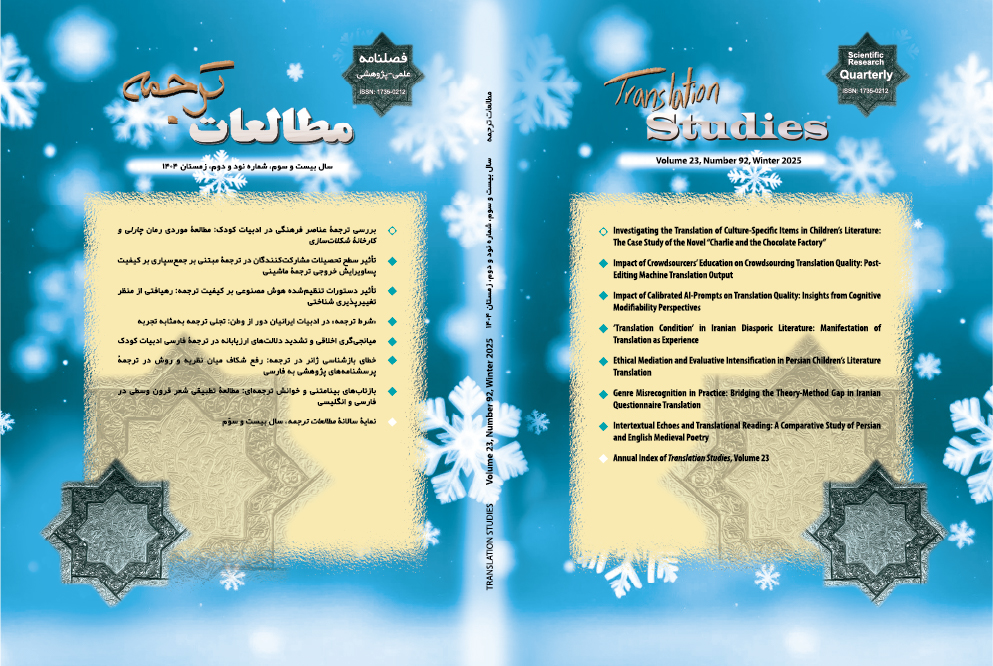
Ethical Mediation and Evaluative Intensification in Persian Children’s Literature Translation
Abstract
Children’s literature is often translated within strong pedagogical and cultural expectations, yet we still know relatively little about how translators shape the ethical tone of a story through everyday linguistic choices. This article examines how translator agency operates as a form of ethical mediation in the Persian translation of Jeff Brumbeau’s The Quiltmaker’s Gift (2000), translated by Ferydoun Faryad (2004). Drawing on virtue-oriented translation ethics and Appraisal Theory, the study conducts a qualitative close comparison of selected source and target passages in order to trace shifts in evaluative language. The analysis identifies five recurring strategies of ethical intensification—affective dramatization, emotional interiorization, sensory magnification, lexical compassion, and cosmological enlargement—through which the Persian translation foregrounds moral and emotional cues with greater perceptual vividness. These shifts systematically strengthen resources of Affect, Judgement, and Appreciation while leaving the narrative structure unchanged. The article argues that such micro-level adjustments function as a form of ethical mediation, aligning evaluative meanings with culturally familiar ethical discourse. By proposing a framework for observing these shifts, the study contributes to ongoing discussions of translator ethics and suggests that domestication in children’s literature may operate through subtle evaluative reshaping rather than overt ideological rewriting.
Keywords:
Appraisal Theory, Children’s literature translation, Ethical intensification, Ethical mediation, Moral indexing, Translator agencyReferences
Alvstad, C. (2019). Children’s literature. In K. Washbourne & B. Van Wyke (Eds.), The Routledge handbook of literary translation (pp. 159–180). Routledge.
Arzuk, D. (2013). Creating a nation from scratch: Nationalism and nationhood in Çocuk children’s periodical in Turkey, 1936–39. In N. Maguire & B. Rodgers (Eds.), Children’s literature on the move: Nations, translations, migrations (pp. 205–217). Four Courts Press.
Baleghizadeh, S., & Ranjour, F. (2010). Manipulation in translation of children’s literature. Iranian Journal of Translation Studies, 8(29), 9–30.
Bixler, P. (1981). Moral tales and the development of children’s literature. Children’s Literature, 9, 1–14.
Brumbeau, J. (2000). The quiltmaker’s gift. Scholastic Press.
Brumbeau, J. (1383/2004). Hediye-ye khuban [The gift of the virtuous] (F. Faryad, Trans.; 13th ed.). Kanoon-e Parvaresh-e Fekri-ye Koodakan va Nojavanan. (Original work published 2000).
Chesterman, A. (2016). Memes of translation (Rev. ed.). John Benjamins.
Chesterman, A. (2020). Virtue ethics in translation. In K. Koskinen & N. K. Pokorn (Eds.), The Routledge handbook of translation and ethics (pp. 13–24). Routledge.
Dybiec-Gajer, J. (2020). Mixing moralizing with enfreakment: Polish-language rewritings of Heinrich Hoffmann’s classic Struwwelpeter (1845). In A. Kérchy & B. Sundmark (Eds.), Translating and transmediating children’s literature (pp. 71–86). Palgrave Macmillan.
Gasser, L., Malti, T., & Buholzer, A. (2022). Children’s moral development through narrative fiction: A review. Journal of Moral Education, 51(2), 143–158.
Ghazanfari Moghaddam, N., Hashemi, M. R., & Ghorban Sabbagh, M. R. (2021). Investigating the effect of powerful institutions on Iranian children’s literature award-winners before and after the Islamic revolution (1961–1988). Iranian Children’s Literature Studies, 11(2), 79–100.
Lambert, J. (2023). Translation ethics. Routledge.
Lathey, G. (2006). The translator revealed: Didacticism, cultural mediation and visions of the child reader in translators’ prefaces. In J. Van Coillie & W. P. Verschueren (Eds.), Children’s literature in translation: Challenges and strategies (pp. 1–19). Routledge.
Lathey, G. (2010). The role of translators in children’s literature: Invisible storytellers. Routledge.
Leonardi, V. (2020). Ideological manipulation of children’s literature through translation and rewriting: Travelling across times and places. Palgrave Macmillan.
Martin, J. R., & White, P. R. R. (2005). The language of evaluation: Appraisal in English. Palgrave Macmillan.
Nodelman, P. (2008). The hidden adult: Defining children’s literature. Johns Hopkins University Press.
Oittinen, R. (2006). No innocent act: On the ethics of translating for children. In J. Van Coillie & W. P. Verschueren (Eds.), Children’s literature in translation: Challenges and strategies (pp. 35–46). Routledge.
Rottman, J., Gentner, D., & Goldwater, M. (2017). Causal learning and moral development. Cognitive Science, 41(3), 784–813.
Shavit, Z. (1986). Poetics of children’s literature. University of Georgia Press.
Vahhabzadeh, K. (2018). Strategies of censorship in translating children’s stories from English into Persian. Translation Studies, 15(60), 95–123.
Wunderlich, R. (1992). The tribulations of Pinocchio: How social change can wreck a good story. Poetics Today, 13(1), 197–219.
Downloads
Published
How to Cite
Issue
Section
DOR
License
Copyright (c) 2026 Mahdi Vahedikia

This work is licensed under a Creative Commons Attribution-NonCommercial 4.0 International License.
Copyright Licensee: Iranian Journal of Translation Studies. This article is an open access article distributed under the terms and conditions of the Creative Commons Attribution–NonCommercial 4.0 International (CC BY-NC 4.0 license).