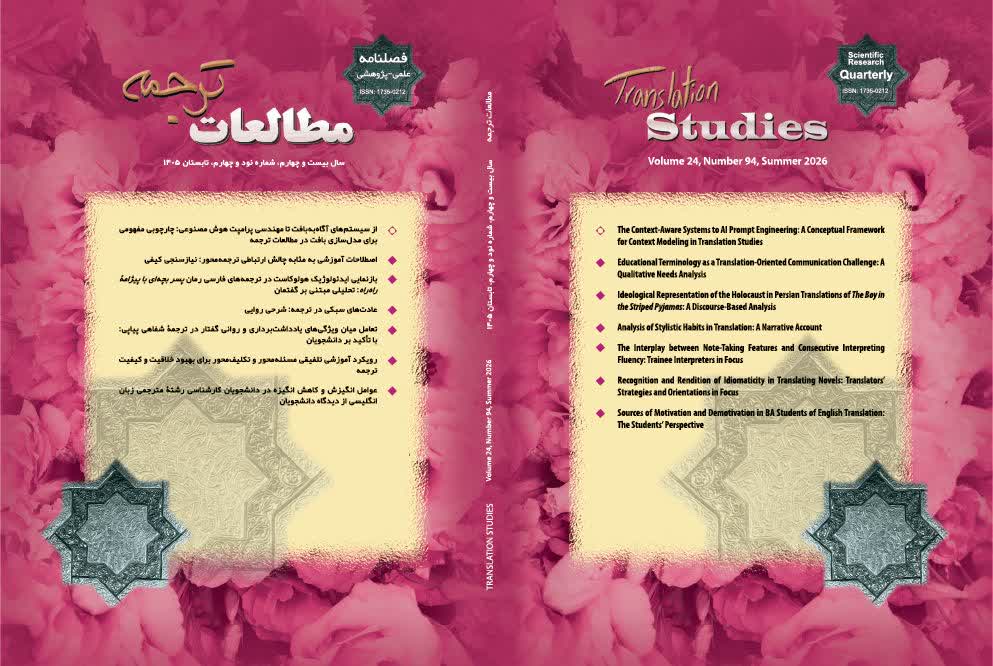
The Interplay between Notes and Consecutive Interpreting Fluency
Trainee Interpreters in Focus
Abstract
This study examines the relationship between interpreting fluency and note-taking features among 13 undergraduate students majoring in English translation. Adopting a quantitative approach, the research investigates four questions: the preference for language choice in note-taking, the tendency to use specific forms (symbols, abbreviations, and full forms) over others, the effects of preferred forms on interpreting fluency, and the correlation between note quantity and fluency. The findings reveal that trainees predominantly favor full forms over symbols and abbreviations, which were used the least. Furthermore, a significant positive correlation exists between the use of full forms and symbols and interpreting fluency, while a positive correlation is observed between note quantity and fluency, suggesting that a higher quantity of notes is associated with higher fluency scores. Additionally, no significant relationship is found between the language of notes and interpreting fluency. These results highlight a link between effective note-taking strategies and interpreting performance, suggesting areas for potential focus in training. This study contributes to understanding how specific note-taking features are associated with the quality of consecutive interpreting, particularly within the context of English-Persian language pairings.
References
Afonina, I. Y. (2022). Note taking for consecutive interpreting: Challenge of teaching, success of performing. In Publishing House “Baltija Publishing” (pp. 84–110). Baltija Publishing. https://doi.org/10.30525/978-9934-26-196-1-4
Alexieva, B. (1993). On teaching note-taking in consecutive interpreting. In C. Dollerup & A. Lindegaard (Eds.), Teaching translation and interpreting 2: Insights, aims, visions (pp. 199–206). John Benjamins.
Bartłomiejczyk, M., & Stachowiak-Szymczak, K. (2022). Modes of conference interpreting: Simultaneous and consecutive. In M. Albl-Mikasa & E. Tiselius (Eds.), The Routledge handbook of conference interpreting (pp. 19–33). Routledge.
Baselli, V. (2012). Which language do interpreters use in consecutive interpreting? In Proceedings in advanced research in scientific areas: The 1st virtual international conference (pp. 1252–1257). EDIS-Publishing Institution of the University of Žilina.
Błaszczyk, P., & Hanusiak, D. (2010). The choice of language for note-taking for consecutive interpreting: A Polish perspective. Mikael: Kääntämisen ja tulkkauksen tutkimuksen aikakauslehti, 4(1), 45–62.
Cardoen, H. (2012). The effect of note taking on target-text fluency [Master's thesis, KU Leuven]. Lirias.
Chen, S. (2016). Note-taking in consecutive interpreting: A review with special focus on Chinese and English literature. The Journal of Specialised Translation, 26(1), 151–171.
Dai, W., & Xu, H. (2007). An empirical study on the characteristics of interpreters' notes in the process of Chinese-English consecutive interpreting: A case study of professionally trained interpreters and non-professional interpreters. Foreign Language Teaching and Research, 39(2), 136–144. https://doi.org/10.3969/j.issn.1000-0429.2007.02.009
Dam, H. (2004). Interpreters' notes: On the choice of language. Interpreting, 6(1), 3–17. https://doi.org/10.1075/intp.6.1.03dam
Dam, H. (2007). What makes interpreters' notes efficient? In Y. Gambier, R. Stolze, & M. Shlesinger (Eds.), Doubts and directions in translation studies (pp. 183–197). John Benjamins.
Dam, H. (2010). Consecutive interpreting. In Y. Gambier & L. V. Doorslaer (Eds.), The handbook of translation studies (pp. 75–79). John Benjamins.
Dam, H., Engberg, J., & Schjoldager, A. (2005). Modelling semantic networks on source and target texts in consecutive interpreting: A contribution to the study of interpreters' notes. In H. Dam, J. Engberg, & H. Gerzymisch-Arbogast (Eds.), Knowledge systems and translation (pp. 227–254). De Gruyter Mouton. https://doi.org/10.1515/9783110924305.227
Gile, D. (1997). Conference interpreting as a cognitive management problem. In J. H. Danks, G. M. Shreve, S. B. Fountain, & M. McBeath (Eds.), Cognitive processes in translation and interpreting (pp. 196–214). Sage Publications.
Gile, D. (2009). Basic concepts and models for interpreter and translator training (Rev. ed.). John Benjamins.
Gillies, A. (2017). Note-taking for consecutive interpreting: A short course. Routledge.
González, M. A. (2012). The language of consecutive interpreters' notes: Differences across levels of expertise. Interpreting, 14(1), 55–72. https://doi.org/10.1075/intp.14.1.03abu
Herbert, J. (1952). The interpreter's handbook: How to become a conference interpreter. Librairie de l'Université.
Ilg, G. (1988). La prise de notes en interprétation consécutive: Une orientation générale. Parallèles, 10, 45–62.
Ilg, G., & Lambert, S. (1996). Teaching consecutive interpreting. Interpreting, 1(1), 69–99. https://doi.org/10.1075/intp.1.1.05ilg
Jones, R. (1998). Conference interpreting explained. St. Jerome.
Kohn, K., & Albl-Mikasa, M. (2002). Note-taking in consecutive interpreting: On the reconstruction of an individualized language. Linguistica Antverpiensia, New Series–Themes in Translation Studies, 1, 257–272.
Liu, J. (2010). Note-taking characteristics of English majored undergraduates in Chinese-English consecutive interpreting: An empirical study based on students' consecutive interpreting notes. Foreign Language World, 31(2), 47–53.
Marani, R., & Heidari Tabrizi, H. (2017). Professional interpreters' notes in Persian-English consecutive interpreting on the choice of form and language. Research in English Language Pedagogy, 5(2), 133–146.
Matyssek, H. (2019). Handbuch der Notizentechnik für Dolmetscher. Julius Groos Verlag.
Pöchhacker, F. (2012). Conference interpreting. In K. Malmkjaer & K. Windle (Eds.), The Oxford handbook of translation studies (pp. 210–220). Oxford University Press.
Pöchhacker, F. (2016). Introducing interpreting studies (2nd ed.). Routledge.
Rennert, S. (2010). The impact of fluency on the subjective assessment of interpreting quality. The Interpreters' Newsletter, 15, 101–115. https://www.researchgate.net/publication/265193450_The_impact_of_fluency_on_the_subjective_assessment_of_interpreting_quality
Rozan, J. F. (1956). Note-taking in consecutive interpreting (A. Gillies, Trans.). Tertium Society for the Promotion of Language Studies.
Seleskovitch, D. (1975). Langage, langues et mémoire: Étude de la prise de notes en interprétation consécutive. Minard Lettres Modernes.
Seleskovitch, D., & Lederer, M. (1989). Pédagogie raisonnée de l'interprétation. Didier Erudition.
Setton, R., & Dawrant, A. (2016a). Conference interpreting: A complete course. John Benjamins.
Setton, R., & Dawrant, A. (2016b). Conference interpreting: A trainer's guide. John Benjamins.
Shafiei, S., Tavakoli, M., & Dastjerdi, H. V. (2017). Delving into note-taking technique in consecutive interpreting: Academic context in focus. Iranian Journal of Translation Studies, 14(56), 67–82.
Stenzl, C. (2002). [Review of the book Interpretazione simultanea e consecutiva: Problemi teorici e metodologie didattiche]. Target: International Journal of Translation Studies, 13(1), 172–177. https://doi.org/10.1075/target.13.1.15ste
Szabó, C. (2006). Language choice in note-taking for consecutive interpreting. Interpreting, 8(2), 129–147.
Wang, W., Zhou, D., & Wang, L. (2010). An empirical study of note-taking characteristics and output quality in interpreting. Foreign Language World, 31(4), 9–18.
Downloads
Published
How to Cite
Issue
Section
DOR
License
Copyright (c) 2026 Sima Ferdowsi, - Haniyeh Afzali, Rahimeh Roohparvar,

This work is licensed under a Creative Commons Attribution-NonCommercial 4.0 International License.
Copyright Licensee: Iranian Journal of Translation Studies. This article is an open access article distributed under the terms and conditions of the Creative Commons Attribution–NonCommercial 4.0 International (CC BY-NC 4.0 license).