
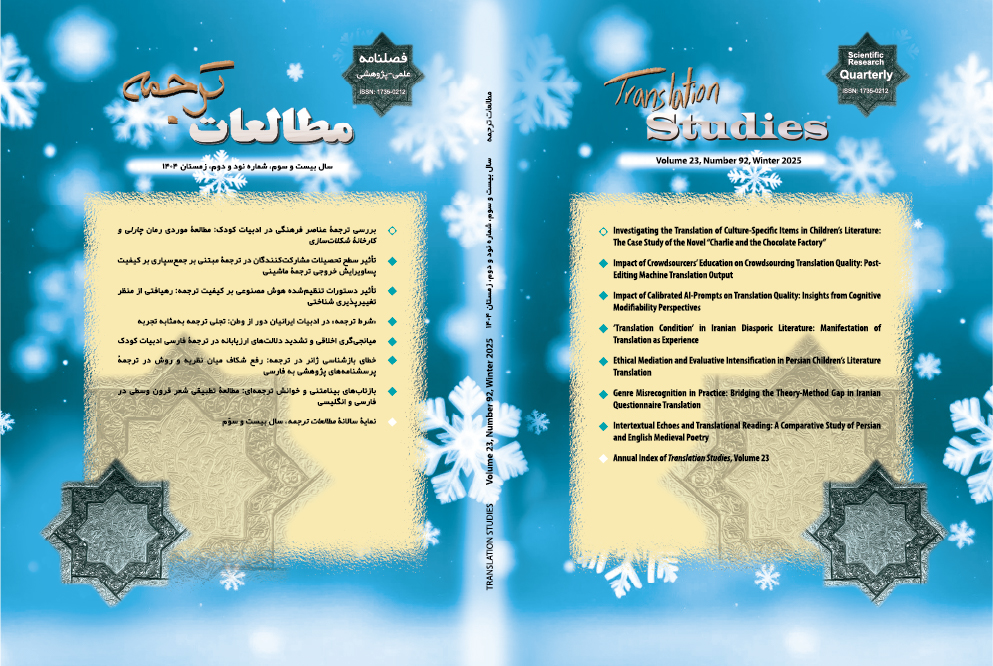
تأثیر سطح تحصیلات مشارکتکنندگان در ترجمۀ مبتنی بر جمعسپاری بر کیفیت
پساویرایش خروجی ترجمۀ ماشینی
چکیده
این مطالعه تأثیر سطح تحصیلات مشارکتکنندگان در ترجمۀ مبتنی بر جمعسپاری بر کیفیت پساویرایش خروجی ترجمۀ ماشینی بررسی میکند. در این پژوهش از مدل جمعسپاری بسته استفاده شد و بستر تلگرام برای جذب مشارکتکنندگان از یک جامعۀ تخصصی مطالعات ترجمه بهکار گرفته شد. مدارک تحصیلی ۳۰ مشارکتکننده تحلیل شد که نشان داد اکثر آنها دارای مدارک تحصیلات تکمیلی هستند: ۱۰ نفر دارای دکتری، ۱۲ نفر دارای کارشناسی ارشد و ۸ نفر دارای کارشناسی در رشته مطالعات ترجمه بودند. یافتهها نشان میدهد که اگرچه سطح تحصیلات شاخص مهمی برای ارزیابی کیفیت پساویرایش است، عوامل دیگری مانند تجربۀ حرفهای و حوزة تخصصی نیز میتوانند بر پساویرایش تأثیرگذار باشند. این مطالعه نشان میدهد که حتی با نمونهای نسبتاً کوچک، میتوان با کنترل دقیق کیفیت دادههای مفید و قابلاعتماد جمعآوری کرد. این مطالعه پیشنهادهایی برای پژوهشهای آتی ارائه میدهد تا تعاملات پیچیده میان متغیرهای مؤثر بر کیفیت ترجمه مورد بررسی قرار گیرد و بر اهمیت توجه به سطح تحصیلات مشارکتکنندگان در پروژههای ترجمه مبتنی بر جمعسپاری تأکید میکند. همچنین، پژوهش مزایای استفاده از مدل جمعسپاری بسته، از جمله بهبود کنترل کیفیت، حفظ محرمانگی و دسترسی به دانش تخصصی را برجسته میسازد. در مجموع، این مطالعه دانش ما را درباره کیفیت ترجمه در زمینههای جمعسپاری گسترش داده، و پیشنهادهایی برای بهبود فرایندهای ترجمه در آینده ارائه میدهد.
کلمات راهنما:
: پساویرایش، پیشینة تحصیلی، ترجمة ماشینی، ترجمة مبتنی بر جمعسپاری، مدل جمعسپاری بستهمراجع
Aikawa, T., Yamamoto, K., & Isahara, H. (2012). The impact of Crowdsourcing post-editing with the collaborative translation framework. Advances in Natural Language Processing, 1–10.
Anastasiou, D., & Gupta, R. (2011). Comparison of crowdsourcing translation with machine translation. Journal of Information Science, 37(6), 637–659.
Azari, R., Ganjalikhani, M. K., & Amirshoja’i, A. (2018). Legislation for patient information leaflets in Iran: Focus on lay-friendliness. Health Promotion Perspectives, 8(4), 263. https://doi.org/10. 15171/hpp.2018.37
Azari, R., Ganjalikhani, M. K., & Amirshoja’i, A. (2020). Crowdsourcing translation: An experience of a cloud-based messaging app. Iranian Journal of Translation Studies, 17(68), 7–22.
Aziz, W., Castilho, S., & Specia, L. (2012, May). PET: a Tool for Post-editing and Assessing Machine Translation. In LREC (pp. 3982–3987).
Badziński, A. (2018). Collocations, equivalence and untranslatability as selected critical aspects in medical translation. Towards Understanding Medical Translation and Interpreting, Gdańsk: Wydawnictwo Uniwersytetu Gdańskiego, 67–83.
Beeby, A., Fernández, M., Fox, O., Albir, A., Kozlova, I., Kuznik, A., ... & Wimmer, S. (2009). Results of the validation of the PACTE translation competence model: Acceptability and decision making. Across Languages and Cultures, 10(2), 207–230.
Brabham, D. C. (2008). Crowdsourcing as a model for problem solving: An introduction and cases. Convergence, 14(1), 75–90.
Dolmaya, J. M. (2018). Analyzing the Crowdsourcing Model and Its Impact on Public Perceptions of Translation 1. In Non-Professional Translating and Interpreting (pp. 167–191). Routledge.
Dunne, D. (2022). A post-editing approach to machine translation evaluation at the document-level.
DePalma, D. A., & Kelly, N. (2011). Project management for crowdsourced translation. American Translators Association Scholarly Monograph Series, 379–408.
Estellés-Arolas, E., Navarro-Giner, R., & González-Ladrón-de-Guevara, F. (2015). undefined. Advances in Crowdsourcing, 33–48.
Estellés-Arolas, E., & González-Ladrón-de-Guevara, F. (2012). Towards an integrated crowdsourcing definition. Journal of Information Science, 38(2), 189–200.
https://doi.org/10.1177/0165551512437638
Fuente, L. C. (2015). Motivation to collaboration in TED open translation project. International Journal of Web Based Communities, 11(2), 210.
Gao, M., Xu, W., & Callison-Burch, C. (2015). Cost optimization in crowdsourcing translation: Low cost translations made even cheaper. In Proceedings of the 2015 Conference of the North American Chapter of the Association for Computational Linguistics: Human Language Technologies (pp. 705–713).
Gritti, A. (2012). Crowd outsourcing for software localization (Master's thesis, Universitat Politècnica de Catalunya).
Howe, J. (2006). The rise of crowdsourcing. Wired magazine, 14(6), 176–183.
Hurtado Albir, A. (2015). The Acquisition of Translation Competence. Competences, Tasks, and Assessment in Translator Training. Meta, 60(2), 256–280. https://doi.org/10.7202/1032857ar
Jaworski, R., Seljan, S., & Dunđer, I. (2017, November). Towards educating and motivating the crowd–a crowdsourcing platform for harvesting the fruits of NLP students' labour. In Proc. 8th Language & Technology Conference–Human Language Technologies as a Challenge for Computer Science and Linguistics (pp. 332–336).
Jiménez-Crespo, M. A. (2013). Crowdsourcing, corpus use, and the search for translation naturalness. Translation and Interpreting Studies, 8(1), 23–49.
Jiménez-Crespo, M. (2016). Mobile Apps and Translation Crowdsourcing: The Next Frontier in the Evolution of Translation. Tradumàtica: Tecnologies De La Traducció, 75–84.
Jiménez-Crespo, M. A. (2017). Crowdsourcing and online collaborative translations: Expanding the limits of translation studies. John Benjamins.
Jiménez-Crespo, M. A. (2018). Crowdsourcing and translation quality: Novel approaches in the language industry and translation studies. In Translation quality assessment (pp. 69–93). Springer, Cham.
Khalilizadeh Ganjalikhani, M., Hesabi, A., & Ketabi, S. (2024). Evaluating linguistic comprehensibility of Persian healthcare translations in multilingual contexts: A case study of health translations website from the Victorian Government of Australia. International Journal of Multilingualism, 21(4), 2307–2324. https://doi.org/10.1080/14790718.2023.2236150
Khalilizadeh Ganjalikhani, M., Hesabi, A. and Ketabi, S. (2023). Toward Crowdsourcing Translation Post-editing: A Thematic Systematic Review. Iranian Journal of Applied Language Studies, 15(2), 1–18. doi: 10.22111/ijals.2023.46015.2358
Lommel, A. (2018). Metrics for translation quality assessment: A case for standardising error typologies. In Translation quality assessment: From principles to practice (pp. 109–127). Cham: Springer International Publishing.
Mao, A., Kamar, E., Chen, Y., Horvitz, E., Schwamb, M., Lintott, C., & Smith, A. (2013). Volunteering versus work for pay: Incentives and tradeoffs in crowdsourcing. Proceedings of the AAAI Conference on Human Computation and Crowdsourcing,
Mesipuu, M. (2012). Translation crowdsourcing and user-translator motivation at Facebook and Skype. Translation Spaces, 1, 33–53.
Morera-Mesa, A. (2014). Crowdsourced translation practices from the process flow perspective. PhD diss., University of Limerick.
O’Hagan, M. (2021). Community translation: Translation as a social activity and its possible consequences in the advent of Web 2.0 and beyond. Linguistica Antverpiensia, New Series—Themes in Translation Studies, 10.
Quinci, C. (2015). Translators in the Making: An Empirical Longitudinal Study on Translation Competence and its Development. Università degli studi di Trieste. http://hdl.handle.net/10077/10986
Ranard, B. L., Ha, Y. P., Meisel, Z. F., Asch, D. A., Hill, S. S., Becker, L. B., ... & Merchant, R. M. (2014). Crowdsourcing—harnessing the masses to advance health and medicine, a systematic review. Journal of general internal medicine, 29, 187–203.
Salam, Z. M., Akil, M., & Rahman, A. Q. (2017). Translation errors made by Indonesian-English translators in Crowdsourcing translation application. ELT Worldwide: Journal of English Language Teaching, 4(2), 195.
Sutherlin, G. (2013). A voice in the crowd: Broader implications for crowdsourcing translation during crisis. Journal of Information Science, 39(3), 397–409.
Zhang, M., & Huang, Z. (2022). Crowdsourcing used in higher education: an empirical study on a sustainable translation teaching mode based on crowdsourced translation. Sustainability, 14(6), 3140.
Downloads
چاپشده
ارجاع به مقاله
شماره
نوع مقاله
DOR
مجوز
حق نشر 2026 Marziyeh Khalilizadeh Ganjalikhani

این پروژه تحت مجوز بین المللی Creative Commons Attribution-NonCommercial 4.0 می باشد.
Copyright Licensee: Iranian Journal of Translation Studies. This article is an open access article distributed under the terms and conditions of the Creative Commons Attribution–NonCommercial 4.0 International (CC BY-NC 4.0 license).