
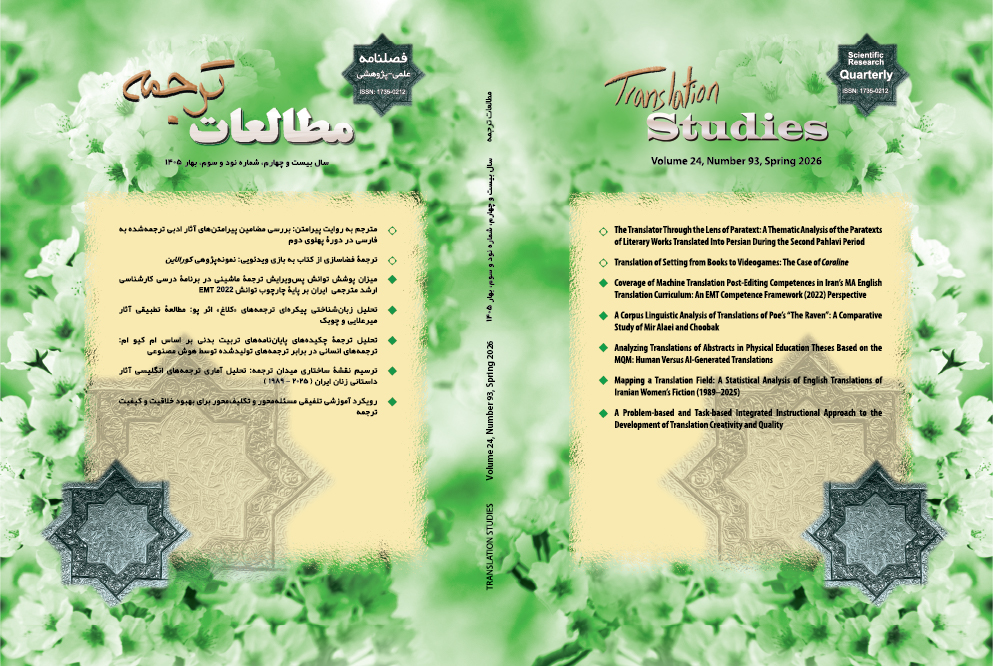
میزان پوشش توانش پسویرایش ترجمۀ ماشینی در برنامۀ درسی کارشناسی ارشد مترجمی ایران بر پایۀ چارچوب توانش EMT 2022
An EMT Competence Framework (2022) Perspective
چکیده
امروزه پسویرایش ترجمۀ ماشینی به یکی از توانشهای ضروری در فرایند ترجمه تبدیل شده است، اما چگونگی ادغام این مهارت در برنامههای آموزشی تربیت مترجم کمتر مورد بررسی قرار گرفته است. پژوهش موردی حاضر، میزان انطباق برنامۀ درسی کارشناسی ارشد مترجمی زبان انگلیسی ایران را با چارچوب توانش کارشناسی ارشد ترجمۀ اروپا (EMT 2022) بررسی میکند. با استفاده از تحلیل محتوای دومرحلهای، واحدهای درسی بر اساس پنج حوزۀ توانش EMT دستهبندی و اهداف یادگیری از طریق ماتریس توانشی مبتنی بر EMT 2022، استاندارد ISO 18587:2017 و مدلهای پسویرایش ارزیابی شدند. پایایی کدگذاری (κ=0.81) بود. یافتهها نشان داد حوزههای ترجمه و زبان و فرهنگ ۷۵ درصد واحدها را دربرمیگیرند، درحالیکه سهم فناوری تنها ۶.۲۵ درصد است و توانشهای بینافردی و ارائه خدمات فاقد درس مستقلند. در سطح اهداف یادگیری، ۶۳.۲ درصد مؤلفههای EMT پوشش رسمی نداشتند و آموزش صریح مرتبط با پسویرایش (سواد ترجمۀ ماشینی، تحلیل خطا، راهبردهای پسویرایش، ارزیابی کیفیت و ملاحظات اخلاقی) وجود ندارد. نتایج نشان میدهد آموزش ترجمه در ایران همچنان سنتی و متنمحور است. پیشنهاد میشود آموزشهای فناورانه گسترش یابد، پسویرایش بهتدریج در برنامه ادغام شود و برنامهها با چارچوبهای بینالمللی همسو گردند.
مراجع
Beikian, A., Ketabi, S., & Hesabi, A. (2020). Effectiveness evaluation of B.A. English translation curriculum from the students’ and graduates’ viewpoints. Journal of Foreign Language Research, 9(4), 1229–1266.
Bell, R. T. (1991). Translation and translating: Theory and practice. Longman.
Birjandi, P., & Nosratinia, M. (2009). The qualitative program evaluation of the postgraduate English translation major in Iran. The Journal of Modern Thought in Education, 4(2), 37–58.
Bowen, G. A. (2009). Document analysis as a qualitative research method. Qualitative Research Journal, 9(2), 27–40.
Davari, H., Nourzadeh, S., Firoozian Pouresfahani, A., & Hassani, G. (2021). An Evaluation and Criticism of the Revised BA Program in English Translator Training. Pizhuhish nāmah-i intiqādī-i mutūn va barnāmah hā-yi ̒ulūm-i insāni (Critical Studies in Texts & Programs of Human Sciences), 21(10), 167–190.
European Commission. (2022). EMT competence framework 2022. European Master’s in Translation (EMT) Board and Competence Task-Force. https://commission.europa.eu/system/files/2022-11/emt_competence_fwk_2022_en.pdf
Farahzad, F., & Jazeb, M. (2021). Components of translation competence: A job task analysis. Iranian Journal of Translation Studies, 19(75), 77–95.
Gene, V., & Guerrero, L. (2022). A common machine translation post-editing training handbook for academia, clients, LSPs and post-editors. GALA MTPE Training Special Interest Group.
Ginovart Cid, C., & Colominas Ventura, C. (2021). The MT post-editing skill set: Course descriptions and educators’ thoughts. In M. Koponen, B. Mossop, I. S. Robert, & G. Scocchera (Eds.), Translation revision and post-editing: Industry practices and cognitive processes (pp. 203–218). Routledge.
Goruh-e Olum-e Ensani, Komite-ye Takhasosi-ye Zaban-haye Khareji. (1999). Moshakhasat-e kolli, barname-ye darsi va sharh-e dorus-e dore-ye karshenasi-ye arshad-e reshte-ye tarjome-ye zaban-e Englisi: Mosavvab-e se-sad-o-chaharomin jalse-ye Shoraye Ali-ye Barnamerizi, Vezarat-e Farhang va Amuzesh-e Ali. Vezarat-e Farhang va Amuzesh-e Ali. https://www.msrt.ir/fa/grid/283
Hassani, G. (2025). A comparative analysis of Iranian translation education: Benchmarking BA and MA programs against the European Master’s in Translation (EMT) Competence Framework. The International Journal of Humanities, 32(2), 80–105. https://doi.org/10.48311/eijh.2025.28042
Hsieh, H.-F., & Shannon, S. E. (2005). Three approaches to qualitative content analysis. Qualitative Health Research, 15(9), 1277–1288.
International Organization for Standardization. (2017). ISO 18587:2017—Translation services: Post-editing of machine translation output—Requirements. https://doi.org/10.3403/30279909
Kaveh, F., & Karimnia, A. (2015). Translation studies program evaluation at master’s level in Iran: A study on Islamic Azad University curriculum design. Journal of Applied Linguistics, 1(2), 21–30.
Kelly, D. (2014). A Handbook for Translator Trainers. Routledge.
Khazaeefarid, A. (2001). Tarjomeh, amoozesh zaban va tarbiateh motarjem [Translation, language teaching, and translator training]. Motarjem Journal, 7(28), 3–11.
Khoshsaligheh,M , Moghaddas, M and Ameri,S . (2019). English Translator Training Curriculum Revisited: Iranian Trainees' Perspectives. Teaching English Language, 13(2), 181–212. doi: 10.22132/tel.2019.96238
Kiraly, D. (2012). Growing a project-based translation pedagogy: A fractal perspective. Meta, 57(1), 82–95. https://doi.org/10.7202/1012742ar
Koponen, M. (2016). Is machine translation post-editing worth the effort? A survey of research into post-editing and effort. Journal of Specialised Translation, 25, 131–148.
Koponen, M., Mossop, B., Robert, I. S., & Scocchera, G. (Eds.). (2021). Translation revision and post-editing: Industry practices and cognitive processes. Routledge. https://doi.org/10.4324/9781003096962
Mellinger, C. D. (2017). Translators and machine translation: Knowledge and skills gaps in translator pedagogy. The Interpreter and Translator Trainer, 11(4), 280–293.
Humanities Group, Foreign Languages Specialized Committee. (1999). General specifications, curriculum, and course descriptions for the MA in English Translation, approved at the 304th session of the Supreme Council for Planning, Ministry of Culture and Higher Education. Ministry of Science, Research and Technology. https://www.msrt.ir/fa/grid/283
Mollanazar, H. (2003). B.A./M.A. programs in translation: The status quo. Translation Studies, 1(2), 7–26.
Mollanazar, H., & Beni, S. S. (2023). Translation and ESP textbooks evaluation: The case of extra-linguistic sub-competence needs in legal and journalistic sources. Iranian Journal of Translation Studies, 21(81).
Motallebzadeh, K., Samir, A., Ashraf, H., & Ghonsooly, B. (2019). Investigating the curriculum of M.A. English translation in prominent Asian universities. Journal of Foreign Language Research, 9(1), 217–253.
Nitzke, J., & Hansen-Schirra, S. (2021). A short guide to post-editing. Language Science Press.
Nitzke, J., Hansen-Schirra, S., & Canfora, C. (2019). Risk management and post-editing competence. Journal of Specialised Translation, 31, 239–259.
O’Brien, S. (2012). Translation as human–computer interaction. Translation Spaces, 1(1), 101–122.https://doi.org/10.1075/ts.1.05obr
PACTE. (2003). Building a Translation Competence Model, In: Alves, F. (Ed.) Triangulating Translation: Perspectives in process-oriented research. Amsterdam: John Benjamins. 43–66. https://doi.org/10.1075/btl.45.06pac
PACTE. (2017) Researching Translation Competence by PACTE Group. John Benjamins.
Robert, I., Ureel, J. J., & Schrijver, I. (2022). Translation, translation revision and post-editing competence models: Where are we now?. In The human translator in the 2020s (pp. 44–59). Routledge.
Shahri, N. N., Fatemi, A. H., Khoshsaligheh, M., & Farimani, Z. B. (2016). A didactic approach to curriculum renewal on the basis of market demands: A grounded theory study. International Journal of Curriculum and Instruction, 8(2), 97–116.
Sohrabi, S., Rahimi, R., & Arjmandi, M. (2015). Efficiency of the Iranian translation syllabus at BA level—Deficiency: A new comprehensive model. Advances in Language and Literary Studies, 6(1), 129–142.
Downloads
چاپشده
ارجاع به مقاله
شماره
نوع مقاله
DOR
مجوز
حق نشر 2026 Saeed Ketabi, Rouhullah Nemati Parsa, Mohammadtaghi Shahnazari

این پروژه تحت مجوز بین المللی Creative Commons Attribution-NonCommercial 4.0 می باشد.
Copyright Licensee: Iranian Journal of Translation Studies. This article is an open access article distributed under the terms and conditions of the Creative Commons Attribution–NonCommercial 4.0 International (CC BY-NC 4.0 license).