
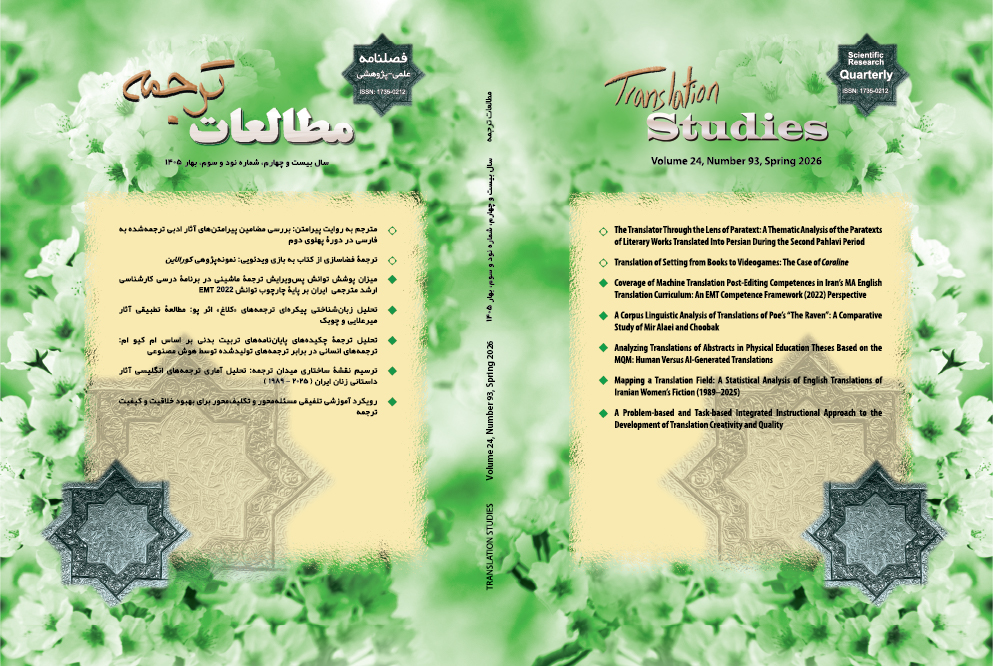
Analyzing Translations of Abstracts in Physical Education Theses Based on the MQM:
Human versus AI-Generated Translations
Abstract
The study focuses on analyzing the quality of abstract translations in Physical Education theses. It aimed to identify errors in human versus AI-generated translations. The paper also aimed to explore human-generated translations using the Multidimensional Quality Metrics (MQM) framework. For this purpose, 30 English abstracts from the field of sports physiology, spanning 15 years (1390s and 1400s/ 2011 to 2025), were selected. Errors were categorized and quantified by type and frequency. The analysis revealed a fluctuating pattern, characterized by a significant recent improvement. Results showed a general upward trend in errors from 2011 to 2020, including a gradual decline in abstract quality—a trend potentially linked to an over-reliance on machine translation. This pattern reversed sharply in the 2020s, with data showing a consistent and marked reduction in errors, culminating in a 71% decrease by 1404 (2025) and reflecting a substantial enhancement in translation quality during the early years of the 1400s (2021–2025).
References
Angelelli, C. (2009). Using a Rubric to Assess Translation Ability: Defining the Construct. In C. Angelelliand H. Jacobson (Eds.), Testing and assessment in translation and interpreting studies. ATA Scholarly Monographs Series. (pp. 13–47). John Benjamins.
Asgari Vartooni, N. (2026). Book Review: Risk Management in Translation. Íkala, Revista de Lenguaje y Cultura, 31(2), 1–5. https://doi.org/10.17533/udea.ikala.363898
Asgari Vartooni, N., Afrouz, M. & Minasian, V. (2026). Error Analysis of English Translations of Persian Sport Sciences Thesis Abstracts. Translation and Interpreting Research, 3(9), 1–18. doi: 10.22054/tir.2026.21086
Bam, R. G. (2005). A Corpus-driven Quantitative Analysis of Translated and Original Texts in 'Die Burger' (Master's thesis). Stellenbosch University. http://hdl.handle.net/10019.1/50242
Boynukara, E. (2017). On the Importance of Translation and Interpretation in Sports and the Reflections of Mistranslation. Journal of Sport and Social Sciences, 4(1), 1–6. https://dergipark.org.tr/tr/pub/jsss/issue/33674/358372
Derakhshi, Z., & KhorramiFard, S. (2019). Quality Assessment of the Persian Translation of John Steinbeck’s of Mice and Men Based on Waddington’s Model of Translation: Application of Method A. Journal of Language and Translation, 9 (3), 29–41.
Herdawan, D. (2020). An analysis on Indonesian-English abstract translation by Google Translate. English Education: Jurnal Tadris Bahasa Inggris, Vol. 13(2), 40–53.
Jafarian, M. (2016). Qualitative Assessment of English Translation into Persian Abstract Iranian Students Dissertations based on the Role-oriented Pragmatic Model of the House (Master's thesis). Islamic Azad University Marvdasht branch. https://ganj.irandoc.as.ir/
Li, H. & Chen, H. (2019). Human vs. AI: An Assessment of the Translation Quality Between Translators and Machine Translation. International Journal of Translation, Interpretation, and Applied Linguistics (IJTIAL), 1(1), 1–12. https://doi.org/10.4018/IJTIAL.2019010104
Löfgren, K. (2014). Terminology, Proper Nouns and Adaption: A Translation Study of Three Sports Texts (Bachelor's thesis), Linnéuniversitetet, Institutionenförspråk (SPR). http://urn.kb.se/resolve?urn=urn:nbn:se:lnu:diva
Lommel, A. R., Burchardt, A., & Uszkoreit, H. (2014). Multidimensional Quality Metrics (MQM): A Framework for Declaring and Describing Translation Quality Metrics. Tradumàtica, (12), 455–463. https://doi.org/10.5565/rev/tradumatica.76
Mahdavi. E, (2017) A TQA of Persian Translations of M.A Theses Abstracts Based on Nord’s Model: A Case Study of M.A Theses of Shahid Bahonar University Translation Students (Master's thesis) Kerman University. https://ganj.irandoc.ac.ir/
Manipuspika, Y. S. (2021). The Effectiveness of Translation Quality Assessment (TQA) Models in the Translation of Indonesian Students. International Journal of Linguistics, Literature and Translation, 4(5), 287–297.
Munawir, M. (2020). The Kinds of Translation Error Made by the Students in Writing Abstract of the Theses and Dissertations. Sang Pencerah: Jurnal Ilmiah Universitas Muhammadiyah Buton, 6(2), 58–66. https://doi.org/10.35326/pencerah.v6i2.723
Napitupulu, S. (2017). Analyzing Indonesian-English Abstracts Translation in View of Translation Errors by Google Translate. International Journal of English Language and Linguistics Research, 5 (2), 15–23.
Terzi, C., & Arslantürk, Y., (2014). An Analysis of Dissertation Abstracts In Terms of Translation Errors and Academic Discourse. International Journal of English Language and Translation Studies, 2(4), 1–11.
Yuan, B. (2019). On Sports English Translation: A Perspective from Linguistic Theories of Translation. Journal of Chengdu Sport University, 45(1): 73–79. DOI: 10.15942/j.jcsu.2019.01.011
Zandi, M. A. (2020). A Translation Quality Assessment of Thesis and Article Abstracts Translated from Persian into English in the Field of Psychology (Master’s Thesis). University of Isfahan.
Downloads
Published
How to Cite
Issue
Section
DOR
License
Copyright (c) 2026 Narjes Asgari Vartooni, Mahmoud Afrouz, Vazgen Minasian

This work is licensed under a Creative Commons Attribution-NonCommercial 4.0 International License.
Copyright Licensee: Iranian Journal of Translation Studies. This article is an open access article distributed under the terms and conditions of the Creative Commons Attribution–NonCommercial 4.0 International (CC BY-NC 4.0 license).