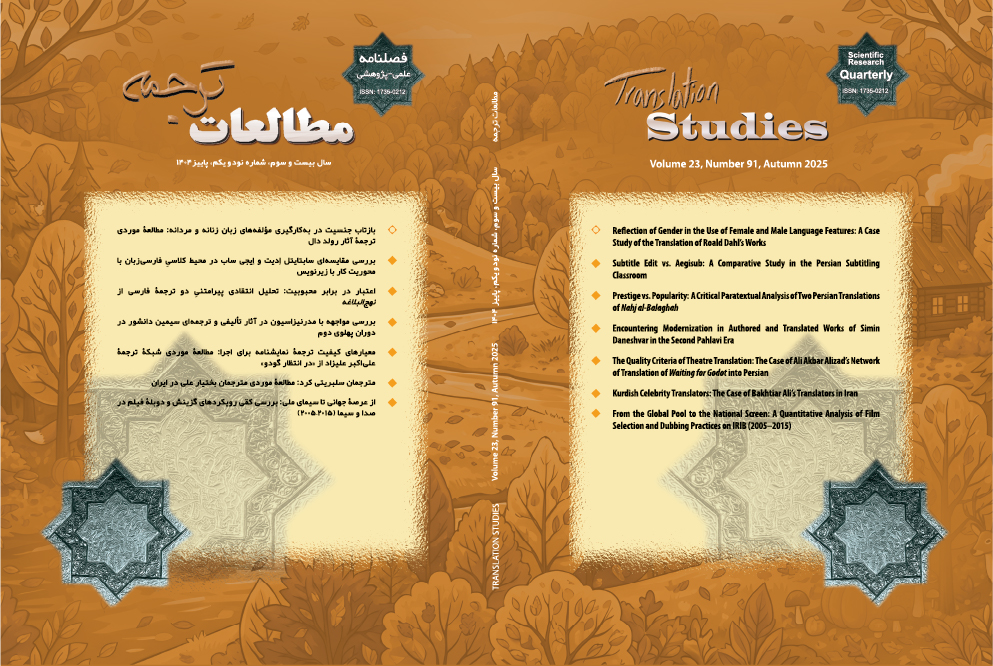
Prestige vs. Popularity:
A Critical Paratextual Analysis of Two Persian Translations of Nahj al-Balagheh
Abstract
This article employs critical paratextual analysis to examine the prefaces of two influential Persian translations of Nahj al-Balaghah: Mohammad Dashti's (1999) and Seyyed Ja'far Shahidi's (1989). Through discourse-analytic close reading informed by Fairclough's (1989, 2013) three-dimensional CDA framework and van Dijk's (1998) socio-cognitive approach, this study reveals how these translators construct competing yet overlapping orientations toward authority, readership, and translation practice. Shahidi's preface emphasizes individual scholarly mastery and literary craftsmanship oriented toward educated readers, positioning translation as aesthetic preservation, while Dashti's preface foregrounds institutional collaboration and communicative accessibility for mass audiences, framing translation as functional mediation. These orientations reflect different value systems in post-revolutionary Iranian culture: Shahidi's translation, which won the Book of the Year Award, prioritizes literary excellence and elite recognition, while Dashti's widely circulated translation emphasizes practical utility and popular appeal. The analysis reveals how post-revolutionary Iranian cultural politics generates a dual validation system where the same religious text can achieve legitimacy through fundamentally different pathways.
References
Blumczynski, P., & Hassani, G. (2019). Towards a meta-theoretical model for translation: A multidimensional approach. Target, 31(3), 328–351. https://doi.org/10.1075/target.17031.blu
Bourdieu, P. (1991). Language and symbolic power. Polity Press.
Bourdieu, P. (2018). Distinction: A social critique of the judgement of taste. In D. B. Grusky & S. Szelényi (Eds.), Inequality: Classic readings in race, class, and gender (pp. 287–318). Routledge. (Original work published 1984)
Dashti, M. (1999). Nahj al-Balaghah (Translation and commentary). Amir-al-Mo'menin Ali (A.S.) Research Institute.
Fairclough, N. (1989). Language and power. Longman.
Fairclough, N. (2013). Critical discourse analysis: The critical study of language (2nd ed.). Routledge.
Genette, G. (1997). Paratexts: Thresholds of interpretation (J. E. Lewin, Trans.). Cambridge University Press. (Original work published 1987)
Koutlaki, S. A. (2002). Offers and expressions of thanks as face enhancing acts: Taarof in Persian. Journal of Pragmatics, 34(12), 1733–1756. https://doi.org/10.1016/S0378-2166(01)00055-8
Munday, J. (2012). Introducing translation studies: Theories and applications (3rd ed.). Routledge.
Nord, C. (1997). Translating as a purposeful activity: Functionalist approaches explained. St. Jerome Publishing.
Schäffner, C. (2014). Third ways and new centres: Ideological unity or difference? In C. Schäffner (Ed.), Apropos of ideology: Translation studies on ideology—Ideologies in translation studies (pp. 23–41). Routledge.
Shahidi, S. J. (1989). Nahj al-Balaghah (Translation and commentary). Elmi va Farhangi Publications.
Simeoni, D. (1998). The pivotal status of the translator's habitus. Target, 10(1), 1–39. https://doi.org/10.1075/target.10.1.02sim
Tahir-Gürçağlar, Ş. (2014). What texts don't tell: The uses of paratexts in translation research. In S. Bermann & C. Porter (Eds.), A companion to translation studies (pp. 44–60). Wiley-Blackwell.
Tasnim News Agency. (2013, May 5). ماجرای عنایت حضرت علی (ع) در ترجمۀ نهجالبلاغه دشتی؛ نظام ما از شما تشکر میکند [The story of Imam Ali's favor in Dashti's translation of Nahj al-Balaghah: "Our system thanks you"]. https://www.tasnimnews.com/fa/news/1392/02/15/51396
van Dijk, T. A. (1998). Ideology: A multidisciplinary approach. Sage Publications.
van Dijk, T. A. (2015). Critical discourse analysis. In D. Tannen, H. E. Hamilton, & D. Schiffrin (Eds.), The handbook of discourse analysis (2nd ed., pp. 466–485). Wiley-Blackwell.
Venuti, L. (1995). The translator's invisibility: A history of translation. Routledge.
Vermeer, H. J., & Chesterman, A. (2021). Skopos and commission in translational action. In L. Venuti (Ed.), The translation studies reader (4th ed., pp. 219–230). Routledge.
Wodak, R., & Meyer, M. (2009). Critical discourse analysis: History, agenda, theory and methodology. In R. Wodak & M. Meyer (Eds.), Methods of critical discourse analysis (2nd ed., pp. 1–33). Sage Publications.
Downloads
Published
How to Cite
Issue
Section
DOR
License
Copyright (c) 2026 Ghodrat Hassani, Seyyed Mohammad Reza Mirseyyed

This work is licensed under a Creative Commons Attribution-NonCommercial 4.0 International License.
Copyright Licensee: Iranian Journal of Translation Studies. This article is an open access article distributed under the terms and conditions of the Creative Commons Attribution–NonCommercial 4.0 International (CC BY-NC 4.0 license).