
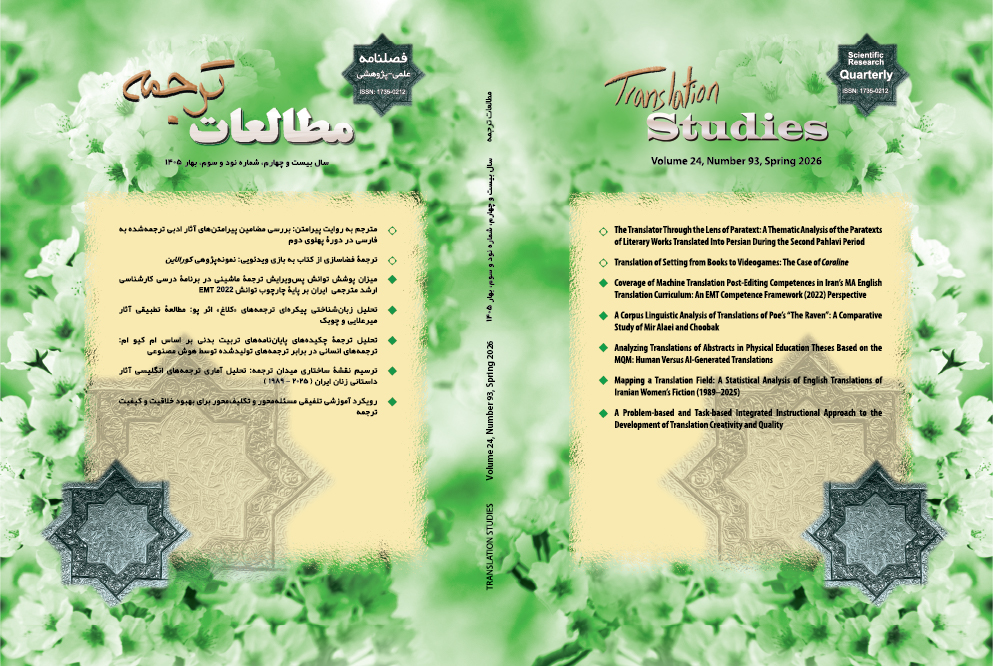
A Problem based and Task based Integrated Instructional Approach to the Development of Translation Creativity and Quality
Abstract
This study investigated the impact of an integrated problem-based and task-based learning (PBL-TBL) approach on the development of translation creativity and translation quality among undergraduate translator trainees. A quasi-experimental pretest-posttest design was employed with 33 fourth-year translation students at Jahad Daneshgahi University of Ahvaz. The 15-week intervention consisted of 15 literary translation tasks designed around authentic, ill-structured objective translation problems as defined by Nord, implemented collaboratively in small groups following a structured problem-based learning cycle. Translation creativity was measured using an adapted model combining acceptability, novelty, and Holst's eight-level ordinal hierarchy of creative shifts; the reported percentages represent the proportion of Units of Creative Potential successfully resolved through acceptable, novel solutions. Translation quality was assessed by means of Waddington's holistic rubric. Repeated-measures ANOVA showed an increase in creativity scores from pre-test (4.44%) to post-test (56.24%), with a large effect size. Quality scores also improved from 5.30 out of 10 to 8.36, and 72.7% of participants achieved ‘Successful’ ratings in the post-test. While the absence of a control group is acknowledged as a limitation, the magnitude and timing of the observed gains suggest that maturation effects alone are unlikely to account for the improvements. The findings appear to indicate that a structured PBL-TBL curriculum may be associated with noticeable gains in translation creativity and quality, offering support for the view that creativity is a teachable competence.
References
Altuwairesh, N. (2024). Using Metacognitive Questionnaires to Develop Translator Trainees’ Strategic Sub-competence: A Case Study. International Journal of English Linguistics, 14(5), 64–77.
Angelelli, C. V. (2009). Using a rubric to assess translation ability: Defining the construct. In C. V. Angelelli & H. E. Jacobson (Eds.), Testing and assessment in translation and interpreting studies: A call for dialogue between research and practice (pp. 13–47). John Benjamins Publishing Company.
Ansarian, L., & Teoh, M. L. (2018). Problem-Based Language Learning. In Problem-based Language Learning and Teaching: An Innovative Approach to Learn a New Language (pp. 15–24). Springer.
Bayer-Hohenwarter, G. (2010). Comparing translational creativity scores of students and professionals: Flexible problem-solving and/or fluent routine behaviour? Copenhagen studies in language(39), 83–111.
Bayer-Hohenwarter, G. (2013). Triangulating translational creativity scores: A methodological study in translation process research. In C. Way, S. Vandepitte, R. Meylaerts, & M. Bartłomiejczyk (Eds.), Tracks and Treks in Translation Studies: Selected Papers from the EST Congress, Leuven 2010 (pp. 63–85). John Benjamins Publishing Company.
Bayer-Hohenwarter, G., & Kussmaul, P. (2020). Translation, creativity and cognition. In F. Alves & A. L. Jakobsen (Eds.), The Routledge handbook of translation and cognition (pp. 310–325). Routledge.
Du Sautoy, M. (2019). The creativity code: Art and innovation in the age of AI. Harvard University Press.
González-Davies, M. (2004). Multiple voices in the translation classroom: Activities, tasks and projects. John Benjamins.
González Davies, M., & Scott-Tennent, C. (2005). A problem-solving and student-centred approach to the translation of cultural references. Meta, 50(1), 160–179.
Göpferich, S. (2009). Towards a model of translation competence and its acquisition: The longitudinal study TransComp. In S. Göpferich, A. L. Jakobsen, & I. M. Mees (Eds.), Behind the mind: methods, models, and results in translation process research (pp. 11–37). Samfundslitteratur.
Gregorio Cano, A. (2023). Towards the acquisition of strategic competence in translator training: stepping into the translator trainees’ shoes (II). Hikma, 22(1), 123–141.
Guerberof-Arenas, A., & Toral, A. (2022). Creativity in translation: Machine translation as a constraint for literary texts. Translation Spaces, 11(2), 184–212.
Hewson, L. (2016). Creativity in translator training: Between the possible, the improbable and the (apparently) impossible. Linguaculture, 7(2), 9–25.
Holst, J. L. F. (2010). Creativity in translation–a study of various source and target texts [Bachelor’s thesis, Aarhus University]. http://pure.au.dk/portal/files/11416/Creativity_in_Translation.pdf
Hu, Z. (in press). Developing translation problem-solving behaviours through exploratory talk-driven collaborative learning: a quasi-experimental study on process, outcomes and engagement. The interpreter and translator trainer, 1–26. https://doi.org/10.1080/1750399X.2026.2657684
Inoue, I. (2005). PBL as a new pedagogical approach for translator education. Meta, 50(4), 1–21.
Jiménez-Crespo, M. A. (2025). "If students translate like a robot…” or how research on human-centered AI and intelligence augmentation can help realign translation education. The interpreter and translator trainer, 19(3-4), 277–295. https://doi.org/10.1080/1750399X.2025.2542022
Kerkkä, K. (2009). Experiment in the application of problem-based learning to a translation course. Vakki: n julkaisut, 36, 216–227.
Kiraly, D. (2014). A social constructivist approach to translator education: Empowerment from theory to practice. Routledge.
Kussmaul, P. (1995). Creativity in translation. In Training the Translator (pp. 39–54). John Benjamins Publishing Company. https://doi.org/10.1075/btl.10.c2
Kussmaul, P. (2000). Types of creative translating. In A. Chesterman, N. Gallardo San Salvador, & Y. Gambier (Eds.), Translation in Context: Selected Papers from the EST Congress, Granada 1998 (pp. 117–126). John Benjamins Publishing Company. https://doi.org/10.1075/btl.39
López, A. R., Férez, P. C., & Caro, M. R. (2021). The role of creativity on the translation of motion verbs: data on the translation product and process. Onomázein(52), 100–126.
Mackenzie, R. (1998). Creative problem-solving and translator training. In A. Beylard-Ozeroff, J. Králová, & B. Moser-Mercer (Eds.), Translators' strategies and Creativity (Vol. 27, pp. 201–206). John Benjamins.
Mellinger, C. D. (2018). Translation, interpreting, and language studies: Confluence and divergence. Hispania, 100(5), 241–246.
Newman, M. J. (2005). Problem based learning: an introduction and overview of the key features of the approach. Journal of Veterinary Medical Education, 32(1), 12–20.
Nord, C. (2005). Text analysis in translation: Theory, methodology, and didactic application of a model for translation-oriented text analysis. Rodopi.
Orozco, M., & Hurtado Albir, A. (2002). Measuring translation competence acquisition. Meta, 47(3), 375–402.
PACTE. (2009). Results of the validation of the PACTE translation competence model: Acceptability and decision making. Across Languages and Cultures, 10(2), 207–230.
PACTE. (2017). PACTE Translation Competence model: A holistic, dynamic model of Translation Competence. In A. Hurtado Albir (Ed.), Researching translation competence by PACTE group (pp. 35–42). John Benjamins Publishing Company.
Rojo, A. (2017). The role of creativity. In M. O’Brien, D. V. Lewis, & M. Carl (Eds.), The handbook of translation and cognition (pp. 350–368). Routledge.
Savery, J. R. (2015). Overview of problem-based learning: Definitions and distinctions. In A. Walker, H. Leary, C. E. Hmelo-Silver, & P. A. Ertmer (Eds.), Essential readings in problem-based learning: Exploring and extending the legacy of Howard S. Barrows (pp. 5–15). Purdue University Press.
Schäffner, C. (1997). From'good'to'functionally appropriate': Assessing translation quality. Current Issues in Language & Society, 4(1), 1–5.
Stansfield, C. W., Scott, M. L., & Kenyon, D. M. (1992). The measurement of translation ability. The Modern Language Journal, 76(4), 455–467.
Waddington, C. (2001). Different methods of evaluating student translations: The question of validity. Meta, 46(2), 311–325.
Xiang, C. (2024). Research on Applying Problem-Based Learning (PBL) Teaching Mode to Forestry Translation Classrooms. International Journal of New Developments in Education, 6(9), 17–23. https://doi.org/10.25236/IJNDE.2024.060903
Downloads
Published
How to Cite
Issue
Section
DOR
License
Copyright (c) 2026 Jalil Jalali, Dr. Mazdak Bolouri

This work is licensed under a Creative Commons Attribution-NonCommercial 4.0 International License.
Copyright Licensee: Iranian Journal of Translation Studies. This article is an open access article distributed under the terms and conditions of the Creative Commons Attribution–NonCommercial 4.0 International (CC BY-NC 4.0 license).